
How to Write a Vacation Rental Listing That Actually Books: A Guide for Smoky Mountain Cabin Owners
A vacation rental listing is a sales document. Its job is not to describe your cabin — it's to convince a specific guest, scrolling through dozens of options, that yours is the one worth booking. Most listings fail at that job not because the cabin isn't good, but because the listing doesn't communicate what makes it good in a way that actually moves a guest to click "reserve."
This post is a practical guide to building a listing that converts. It covers photography, titles, descriptions, amenity presentation, and the specific mistakes that cause otherwise strong cabins to underperform on Airbnb, VRBO, and similar platforms. Every principle here applies to any Smoky Mountain cabin regardless of size, location, or price point.
Photography: The Only Thing That Gets You the Click
Before a guest reads a single word of your listing, they've already made a preliminary judgment based on your photos. In a market as competitive as the Smoky Mountains — where guests are scrolling through hundreds of options — photography is the difference between a listing that stops the scroll and one that gets passed over in under a second.
Professional Photography Is Not Optional
This is the single most important investment a vacation rental owner can make in their listing, and it's the one most self-managing owners defer or skip. The difference between professional vacation rental photography and owner-shot photos is not subtle — it's the difference between a listing that looks like a product worth booking and one that looks like a Craigslist post.
Professional vacation rental photographers understand how to use natural light, how to frame a room to communicate its actual size and warmth, how to capture the outdoor spaces that define the Smoky Mountain experience, and how to shoot the specific amenities — hot tub, fireplace, mountain view, game room — that guests are filtering for. The result is a set of images that makes a guest feel like they've already chosen the right place before they've booked.
The ROI on professional photography is among the highest available to a vacation rental owner. A listing with strong photos commands higher rates, converts at a higher percentage, and attracts better guests than an identical cabin with weak photos. At Colonial Properties, professional photography is included for every property we onboard — because we've seen the difference too many times to consider listing a cabin without it.
What the Photo Set Needs to Include
A complete, high-performing photo set for a Smoky Mountain cabin typically includes:
Exterior shots. The cabin from the outside, in good light, ideally with mountain or natural surroundings visible. This is often the first photo guests see in search results — it needs to immediately communicate "yes, this is what I'm looking for."
Living spaces. The main living area, shot to communicate warmth and comfort. Good lighting, staged appropriately, no clutter.
Kitchen. Guests who cook care about the kitchen. A well-lit shot of a fully equipped kitchen — especially if it's a strong kitchen — is worth including.
Every bedroom. Each bedroom deserves its own photo. Guests with specific sleeping arrangements need to see that the cabin can accommodate them.
Bathrooms. Often skipped, always worth including if the bathroom is in good condition. A clean, well-lit bathroom photo signals that the cabin is well-maintained.
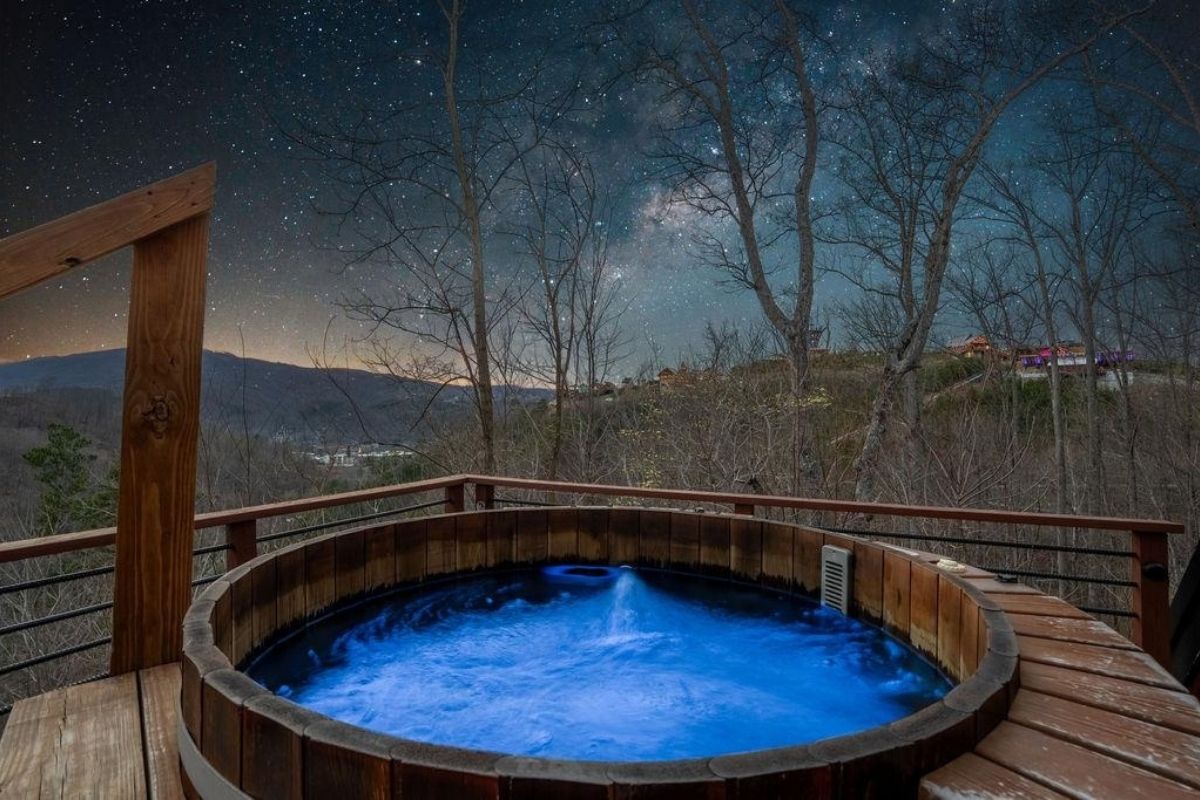
Hot tub. If your cabin has a hot tub, it needs a dedicated photo — ideally shot at dusk or with good lighting that makes it look inviting. This is the photo that converts guests who filtered for hot tub.
Fireplace. A lit fireplace shot is one of the most emotionally resonant images in vacation rental photography. If the cabin has a fireplace, show it lit.
Outdoor spaces. Decks, fire pits, porches, and views deserve their own photos. The outdoor experience is central to the Smoky Mountain cabin appeal.
Views. If the cabin has a mountain view, dedicate at least one photo specifically to it — ideally taken from the deck or porch where guests will actually experience it. A view photo that's shot from inside looking through a window loses much of its impact.
Game room or entertainment spaces. If the cabin has a game room, theater room, or other entertainment feature, show it specifically.
Seasonal variety. A listing with only summer photos doesn't speak to a winter guest imagining a firelit evening. Consider building a photo set that includes images from multiple seasons over time.
Photo Order Matters
The first five photos a guest sees in your listing are the ones that determine whether they click through to read more or keep scrolling. Put your strongest images first — typically the best exterior shot, the living room, the hot tub or most distinctive amenity, the view, and one more interior or outdoor shot that communicates the experience. Save the more functional photos (bathrooms, secondary bedrooms) for later in the set.
The Listing Title: Your First Seven Words
On most platforms, the listing title is what guests see alongside the primary photo in search results. It has one job: make the guest click.
Most listing titles waste this opportunity by describing rather than selling. "3BR Cabin in Pigeon Forge with Hot Tub" is a description. It communicates information but creates no emotional pull. Compare it to "Mountain View Cabin | Private Hot Tub | Fire Pit" — which communicates the same information but emphasizes the experiential elements that actually motivate guests.
A strong Smoky Mountain cabin listing title typically:
Leads with the most distinctive feature. Mountain views, private pool, secluded setting, game room — whatever makes this cabin different from the dozens of similar options nearby. Lead with that.
Includes the most-searched amenities. Hot tub, fireplace, and mountain views are among the most filtered-for amenities in this market. If your cabin has them, they belong in the title.
Avoids filler words. "Beautiful," "amazing," "cozy," and "perfect" are meaningless in a title and waste character space. Guests know these words are there and skip past them.
Uses the platform's character limit efficiently. Airbnb allows 50 characters; VRBO allows more. Use what you have.
The Listing Description: Selling the Experience, Not the Specifications
Most vacation rental descriptions read like a property spec sheet: three bedrooms, two bathrooms, 1,400 square feet, fully equipped kitchen. Guests can see most of this information in the listing's structured fields. What they can't get from a spec sheet is a sense of what it actually feels like to stay there — and that's what a well-written description delivers.
Lead With the Experience, Not the Inventory
The opening paragraph of a listing description is its most important real estate. Most owners waste it on generic statements ("Welcome to our beautiful Smoky Mountain cabin!") that communicate nothing and create no emotional response.
A strong opening puts the guest inside the experience they're imagining:
"Wake up to mountain views from every window, spend your afternoons on the deck listening to the trees, and end your evenings in the private hot tub under the stars — this is what a Smoky Mountain getaway is supposed to feel like."
That opening doesn't describe the cabin — it describes what it feels like to be there. Guests who are imagining that experience are already half-committed before they've read another word.
Describe the Amenities Through the Experience They Create
Rather than listing amenities in bullet points, describe what they make possible. A game room is not just a game room — it's the place where the kids disappear for hours so the adults can actually relax. A fireplace isn't just a fireplace — it's the centerpiece of the evening, the reason you book a cabin in November instead of a hotel. A mountain view isn't just a view — it's what you see from the kitchen window while you're making coffee in the morning.
Bullet points for amenities are fine and necessary for scannability — but the prose description should do the work of making guests feel the experience, not just understand the inventory.
Be Specific About Location and Access
Guests planning a Smoky Mountain trip want to know what they can actually do from your cabin. Specific, accurate information about proximity to Dollywood, the national park entrance, Gatlinburg, Pigeon Forge, and local attractions helps guests self-qualify — and self-qualified guests are better guests, because they booked knowing what to expect.
Avoid vague proximity claims ("minutes from everything!") that mean nothing and occasionally backfire when guests discover "minutes" meant forty-five of them. Be accurate, be specific, and let guests decide whether the location works for their trip.
Address the Practical Questions Proactively
Guests have predictable questions before they book: Is there enough parking? What's the driveway like? Is it suitable for young children? Are pets welcome? Is the hot tub heated year-round? Answering these questions in the listing description reduces pre-booking inquiries, reduces the likelihood of a guest arriving with unmet expectations, and builds confidence that the listing is being honest about the property.
Amenity Presentation: The Details That Drive Filtering
Both Airbnb and VRBO allow owners to select from a list of amenities that guests use to filter search results. A cabin that has an amenity but hasn't listed it won't appear in searches filtered for that amenity — it's invisible to exactly the guests most likely to book it.
Audit your amenity list carefully. Common ones worth confirming are marked on your listing:
- Hot tub
- Fireplace (gas or wood-burning, specify which)
- Mountain view
- Washer and dryer
- Fully equipped kitchen (specific appliances if notable)
- Pet friendly
- Game room
- Free parking
- WiFi (specify speed if it's strong — "fast WiFi" is a search filter on Airbnb)
- Air conditioning and heating
- Outdoor furniture and fire pit
- Dedicated workspace (increasingly searched by remote workers)
Beyond the standard list, both platforms allow custom amenities or notes about specific features. Use these to surface anything distinctive that the standard list doesn't capture.
Pricing Display and Its Effect on Conversion
How your pricing appears in search results affects click-through rates in ways that most owners don't think about.
On Airbnb, the price displayed in search results is the total price including fees — cleaning fee, service fee, taxes. A cabin with a low nightly rate but a high cleaning fee can display a total price that's higher than a comparable cabin with a higher nightly rate and lower fees, creating a price perception problem that reduces clicks.
Cleaning fees in the Smoky Mountain market have become a significant source of guest friction as they've risen across the industry. A cleaning fee that's disproportionately high relative to the nightly rate — particularly for shorter stays — suppresses bookings from guests who feel the total cost doesn't match what they expected from the nightly rate headline.
This doesn't mean eliminating cleaning fees — they cover a real cost. It means thinking about how the total displayed price compares to comparable listings and whether the fee structure is creating an unintended price perception gap.
Keeping the Listing Current
A listing that was strong when it was created gradually loses performance as the property evolves and the market changes around it. Amenities get added that aren't reflected in the listing. Photos become outdated as the cabin is refreshed. Competitor listings improve. Platform algorithms change what they reward.
Listing maintenance — reviewing photos annually, updating the description when significant changes occur, auditing the amenity list, refreshing the title to reflect current positioning — is ongoing work, not a one-time setup task. Listings that get attention consistently outperform those that were set up well once and left alone.
What a Professionally Managed Listing Looks Like
Everything in this post — the professional photography, the optimized title, the experience-led description, the complete amenity presentation, the pricing structure, the ongoing maintenance — is the standard Colonial Properties applies to every listing in our portfolio.
When a new property joins our program, we handle the photography, write the listing, set up the amenity presentation, build the pricing structure, and publish across all major platforms. We then maintain and optimize the listing on an ongoing basis as the market evolves.
Owners who switch to Colonial from self-management or from a previous manager frequently comment on how different their listing looks — and how quickly the difference shows up in booking performance.
If you'd like to see what a professionally managed listing could look like for your specific cabin, our Owner Success Team is happy to walk through it.
Schedule a call with our Owner Success Team
Colonial Properties manages vacation rentals across Pigeon Forge, Gatlinburg, Sevierville, Wears Valley, Douglas Lake, and all of Sevier County. Learn more at managemycabin.com.

